Choosing cabinet materials for Sabah's humid climate
A plain-language guide to cabinet boards, finishes, edge banding and hardware for humid Sabah homes, with where each option tends to suit and what to confirm in your quotation.
Short answer
In Sabah's humidity, the weak points of a cabinet are exposed board edges, the sink base and areas near steam. Choose a board suited to each area, a finish that seals the surface, well-applied edge banding and hardware rated for damp conditions, and keep the space ventilated. Confirm the exact board, finish and hardware in your quotation.
Why humidity matters for cabinetry
Sabah's warm, humid air means cabinet materials are exposed to moisture all year, not only when water is spilled. Board products can absorb moisture through unsealed edges and holes, which can lead to swelling, loose hinges or peeling finishes over time.
The good news is that most problems start at predictable places: the cabinet under the sink, the panels beside a dishwasher or kettle, the area around the hob where steam rises, and bathroom vanities. Planning materials area by area is more useful than choosing one material for everything.
This guide is general guidance. Specific products vary by supplier and grade, so always confirm the exact specification in writing.
Board types in general terms
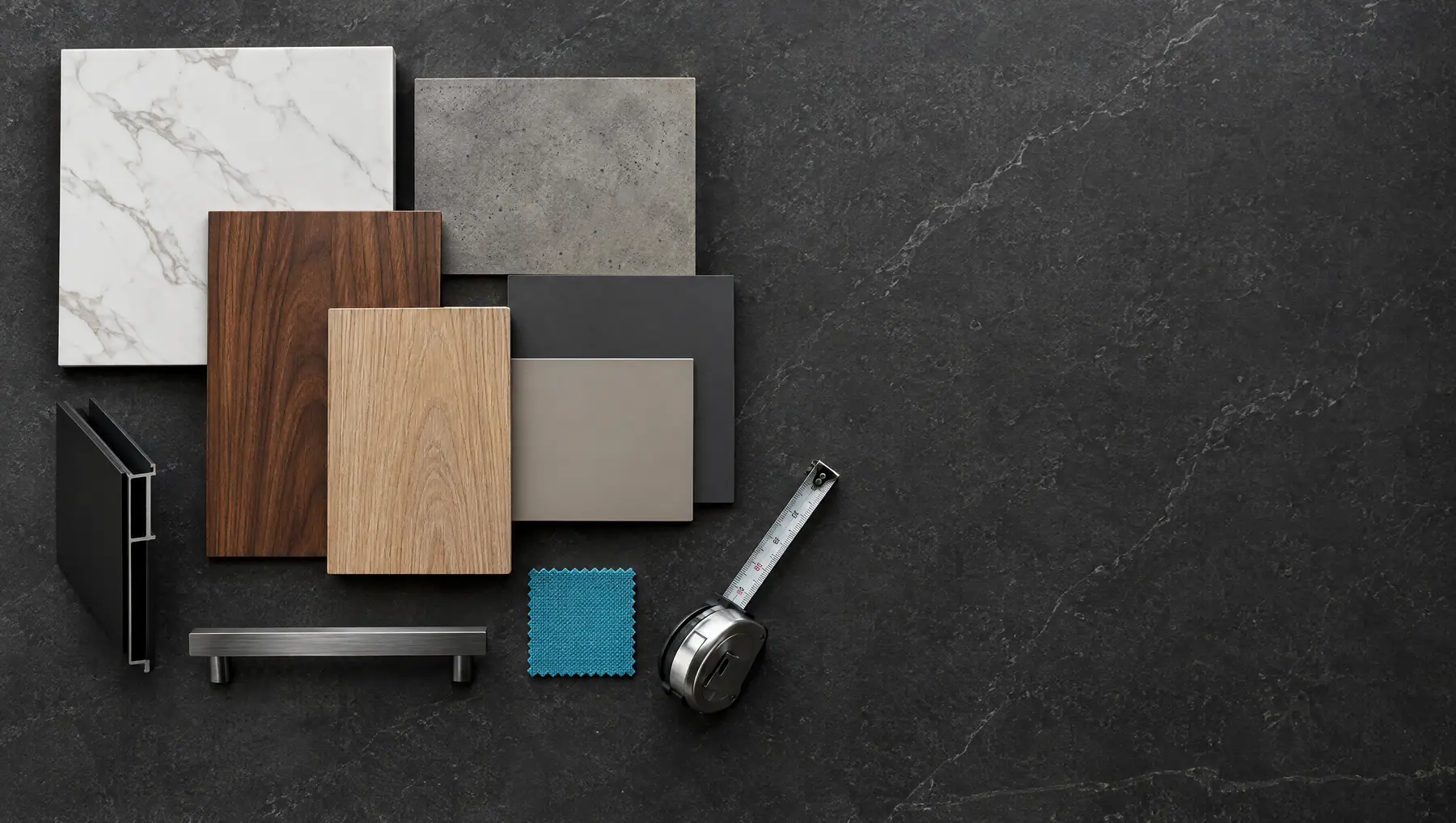
Most modern cabinets are made from engineered boards rather than solid timber, because boards are more stable and consistent. Each type has its strengths.
- Plywood: layers of timber veneer glued together. Generally strong and holds screws well. Quality depends on the grade and glue used.
- Particleboard: wood particles bonded with resin. Economical and flat, commonly used for carcasses. Needs its edges and holes well sealed, especially in damp areas.
- MDF: fine wood fibres pressed into a dense, smooth board. Good for painted or lacquered doors with crisp edges. Standard MDF does not like prolonged wetting.
- Moisture-resistant grades: some particleboard and MDF products are made with moisture-resistant resins. They cope better with humidity but are not waterproof, so sealing still matters.
- Aluminium and other non-timber systems: used for some carcasses, frames and wet-area cabinets. They do not swell with moisture, though the look, fittings and budget differ from board cabinets.
Finishes and what they do
The finish protects the board and sets the look. The right choice depends on the room, how the surface is used and how you prefer to clean.
- Laminate: a hard-wearing decorative layer bonded to the board. Wide range of colours and woodgrains, easy to wipe clean. A popular choice for busy kitchens.
- Melamine: a thinner decorative surface often used on carcass interiors and shelves. Practical and easy to clean.
- Lacquer or paint: a smooth sprayed finish, usually on MDF, in gloss or matt. Looks refined; chips need proper touch-up and edges should be well sealed.
- Veneer: a thin slice of real timber on a board. Natural grain and warmth. Needs a good protective coat and a little more care near water.
Edge banding: the detail that matters most
Edge banding is the strip that covers the cut edge of a board. In a humid climate it is one of the most important details in the whole cabinet, because an unsealed or poorly glued edge lets moisture in.
Ask how edges are banded, whether all visible and hidden edges are sealed, and how cut-outs for sinks, pipes and hobs are protected. Good workshops seal these openings rather than leaving raw board exposed.
Hinges, runners and fittings
Hardware works hard in a kitchen. In humid conditions it is worth asking what the hinges and drawer runners are made of and whether they are suited to damp areas such as the sink base and bathroom vanities.
Soft-close hinges and full-extension runners make daily use more comfortable. Adjustable hinges also allow doors to be realigned later if the building settles or a door drops slightly.
Termites and pests
Termites are a real concern in many Sabah homes, especially landed houses and older buildings. Cabinet boards are not a substitute for proper building pest control.
If you have had termites before, mention it at the site visit. Practical steps include treating the building, keeping cabinets off damp walls and floors where possible, and choosing materials and plinth details that are easier to inspect.
Ventilation and daily habits
Even the best materials last longer in a ventilated room. A good hood that extracts steam from cooking, a bathroom exhaust fan, and a little airflow inside closed cabinets all help.
- Wipe up water around the sink and dishwasher promptly.
- Do not leave kettles or rice cookers steaming directly under wall cabinets.
- Leave the sink cabinet door open occasionally to air it.
- Report any slow leaks from taps or waste pipes early.
Where each option tends to suit
As a general starting point only, many homeowners choose different materials for different zones. Your site, budget and style will shape the final answer.
- Sink base and wet zones: moisture-resistant boards, well-sealed edges or non-timber systems.
- General kitchen carcasses: quality board with melamine interiors and sealed edges.
- Kitchen doors: laminate for everyday toughness, lacquer or veneer for a softer, premium look.
- Wardrobes and living room cabinetry: a wider choice of boards and finishes, as moisture exposure is usually lower.
- Bathroom vanities: materials and hardware chosen for damp conditions, with good ventilation in the room.
What to confirm in your quotation
A quotation that says only 'standard board' or 'premium finish' is hard to compare. Ask for the specification to be written down so you know exactly what you are paying for. Cabchen can advise during the site visit on suitable options for each area of your home.
- Carcass board type and grade for each area, including the sink base
- Door and drawer front material and finish
- Edge banding method and which edges are sealed
- Hinge and runner brand and type
- Worktop material and thickness
- Warranty terms, confirmed in writing
Common questions